Posts mit dem Label Ausstellung werden angezeigt. Alle Posts anzeigen

Freitag, 5. April 2013

Spanish Impressionism

Welcome once again,

This time, my way lead me to Valencia, Spain. I went to visit a friend and of course as part of my mandatory city discovering program several museums were on my plan. My first stop was the Museum of Fine Arts of Valencia. Beautiful, beautiful building by the way!

Apart from the permanent collections, there was a wing solely dedicated to a Valencia-born artist. Joaquin Sorolla y Bastida (1863-1923) exelled at painting portraits, landscapes and works of social and historic themes. The exhibition showed a wonderful selection of some portraits he painted, but also some social themes. He painted in an impressionistic way, very expressive and bold, with vibrant colors. This one, painted in 1900 of Count Artal, made me stand infront of that portriat for a very long time, which rarely happens, since portrait is not my favorite medium of painting.


I love how the picture is divided into different sections by the various lines and diagonals throughout. I love the format, I love the vivid, yet rather undefined background, i love the placement of the portrayed. Beautiful picture.

But another picture I couldn't take my eyes off, was "People in frock coats playing in a garden" which Sorolla completed in 1900.


Isn't it just breathtaking?? I have rarely seen an impressionist painting with so much life in it. The colors are so rich and lush, not only in the depicted nature but also on the people and their costumes. Incredible how Sorolla captured the early autumn sunlight shining through the tall trees and falling on the playful scene. It seems like you can almost smell the freshness of the leaves, the crispness of the air this scene takes place in. What you can't see here, is the format. The picture is actually really huge so it seems, like you're standing right infront of that scene, participating almost in the joyful play. And look at that detail!! 


A true masterpiece!!

Freitag, 8. März 2013

Not ever ForgITTEN again

Fans of color, hello!

Tonight I had the opportunity to visit the exhibition "Itten and Klee" in the Kunstmuseum in Bern, guided by one of the curators herself, Monika Schäfer. 

I have to admit, I hadn't done any research beforehand and I had never heard about "Itten" before so I didn't know what to expect. Is "Itten" a place? A theory or idea? Or is it maybe another person? Pretty soon, almost immediateley it was clear to me, that "Itten" was also an artist of the same era as Paul Klee (1879-1940). Johannes Itten (1888-1967) is also, like Klee, a swiss artist from the 20th century. Not having heard from him before shamed me a little since his works, as I learned, are quite extraordinary. 

The theme of the exhibition was color itself. The cosmos of color to be exact. Both artists spent an enormous amount of time studying colors. Several rooms of the exhibition were just dedicated to show their theoretical approach on color. They both were groundbreaking in our modern understanding of color, colorschemes, colorinteraction etc. And both artists worked their findings on color and their experiments into their works. In a very systematic, almost mathematical way.

The great thing about getting led through an exhibition by someone who created it, is that you get to hear alot of anecdotes. For example one about this piece "Encounter" from 1916 by Johannes Itten. It seems quite systematic, clear composition, colorful. Eventhough you can't see an actual object or something in perticular there is a rather sad backstory. A close personal friend of Itten had taken her life, shortly before this work originated. The greyish spiral that represents the tragic loss meets the more lively and colorful spiral in an intertwined "Encounter". This piece represents a great deal of pain on the artist's part. 

Since I haven't really encountered Itten before, I will focus on another series of works by him, which I thought was enchanting. "Spring", "Summer", "Autumn" and "Winter" are four works of a series from a private collector that were created in 1963. You can again see the focus on the demonstration of colors and how they work together. Itten, more than Klee, also tried to apply the study of colors to other fields of sciences or areas of different focuses. For example he tried to categorize different signs in colors, or feelings and even traits of character. This series although represents his application of color to the different seasons of the year which in my opinion he managed to achieve beautifully. 


Dienstag, 5. März 2013

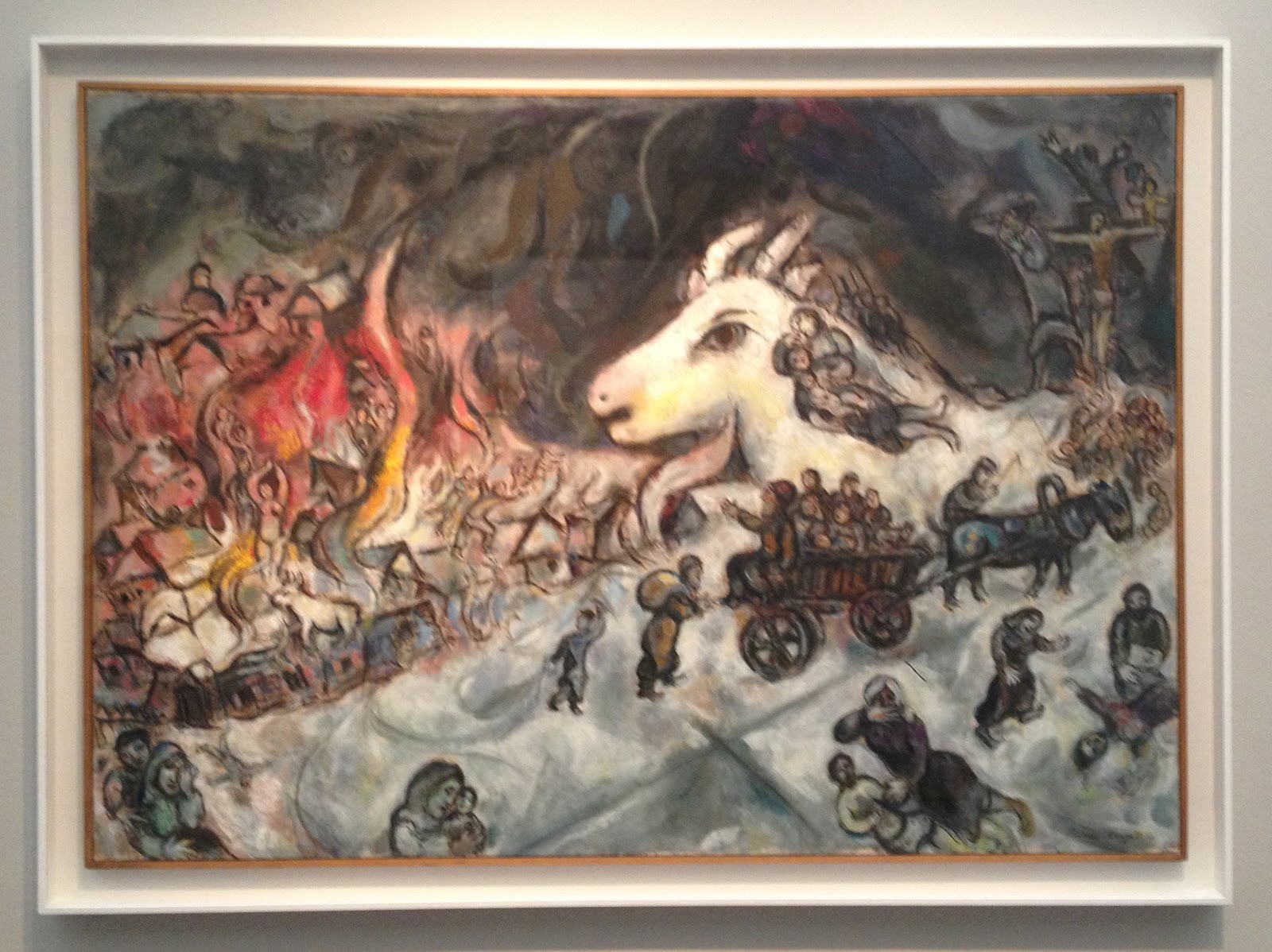
Checking out Chagall

Hi again there,

So there is a pretty big and as it seems important Marc Chagall exhibition at the Kunsthaus in Zurich. As you can imagine I was one of the first ones there. When I began my studies in art Chagall was my of my favorite expressionist painters. The colors and the melancholic tone of his pieces were always something that spoke to me. So naturally I was full of anticipation.

The exhibition was beautifully arranged, as the Kunsthaus always manages to achieve with its shows. The selection of paintings was broad and as I learned it took over two years for the curatorial team to aquire the works, coming from all over the world, from private collections, museums and galleries.

The War 1964-1966

The exhibition focused primarily on the years from 1911 to 1922, a crucial period in Chagall's artistic formation. Over 90 works trace his career in Paris and in is homeland Russia during the period of the revolution. Uniquely among his contemporaries, Chagall developed an art that articulates his Jewish and Russian culture while entering into a dialogue with the visual languages of modern art - from Fauvism to Cubism and Orphism, from Expressionism to Suprematism.

I know I said Chagall was one of my favorite artists when I started at University. But as I was looking at the pieces now I couldn't find the access I used to have to Chagall's poetic, intuitive, almost dreamy pieces of art. Before I found the famous flying cows and violin-playing goats, the floating lovers intriguing and beautiful. Now I found them rather silly, which I know I have no reason for. It all seemed more illustrative, almost childish and the colors seemed to vibrant and intrusive for me.

The Yellow Room 1911

But still, the quality of the works, the selection and the exhibition itself was great and of extraordinary quality. It was also the first time that so many works of different timeperiods of Chagall were united in one room which was a pleasure to see.


Freitag, 1. Februar 2013

Onufri 2012/2013

Hey again, readers.

When I was in Tirana, I was lucky enough to get a chance to see the recurring artshow the National Gallery of Albania (NGA) hosts every year. "Onufri" in its 19th edition was curated by the Italian Daniele Capra under his chosen theme "Perchance to Dream" - a verse from Hamlets famous soliloquy by Shakespeare.

Capra has chosen this title because, according to him, there is a noticeable correspondance between an anguished and confused Hamlet found in a difficult personal circumstance yet, regardless, finds strength to think philosophically about the world and its enigmas. According to Capra the Albanian artists challenge and defy the difficult everyday reality, managing to offer personal solutions.

It was set up like every current artshow. A big open room, white walls and sporadic placement of the artpieces. There were mixed media sculputures, videos, paintings, photographs, drawings... So basically everything you can wish for. The pieces were nice, although I couldn't really find the connection to the theme of the exhibition.

I really liked the photographs by Mariana Kostandini.

"Pa titul"


"Eve"

I didn't really know what to make of them though, and even after contemplating the photographs with the theme of the exhibition in mind I could only come up with this: I think the artist chose to show us how not to use a couch, which could correspond with the theme. It's funny and of course you can apply the "couch-theme" to a bigger scale where the couch could represent something else, like a government, an institution, anything really. But then again, I don't really know and I feel like I'm leaning far out the window here. But besides the difficulty of finding out what they mean, I found the photos aesthetically pleasing and humorous. Great compositions.


Sonntag, 20. Januar 2013

Happy Belated Holidays! Have some turkey!

Hey festive ones,

I wish you all a very belated but still a very merry Christmas, a happy New Year, happy Hanukkah or whatever you choose to celebrate! Oh, and also happy Birthday to my dad who went with me to see what I am about to present to you.

And in the spirit of the holidays (that allready passed a while ago, I know) I think it only makes sense to dedicate this piece of art to those festive times I hope we all were able to enjoy!


We went to see a student art show in Tirana, Albania, and this piece caught my eye immediateley. It's called "Gjeli i arte" which means golden rooster in albanian. And the young artist's name is Flogert Kola and unfortunately I couldn't find any info on this yet unknown artist.

But I thought this piece was brilliant. It's simple, it's well made, it's humoristic and sarcastic. The material is, as you can see, carved styrofoam which is an incredibly cheap material, almost garbage since it's mostly used for packaging and gets thrown away after. So it's ironic that the artist chose to use this material to display something that gets valued so much particularly during the festive season. The main attraction on the dinnertable is the turkey - that's the tradition. But then again by painting it gold, the artist gives it back some value. It may be made of styrofoam but it's golden and therefore important again. And the pairing with the festive red tablecloth gives it an impression of being displayed in a most fancy way, in the most festive way possible. And it also leads me to believe that it is an installation and not just a sculpture.

As I said, great work! And happy belated Holidays again!

Freitag, 31. August 2012

Kolorful. Kute. Kolossal. Koons

Hello,

Jeff Koons at the Fondation Beyeler in Basel. Of course I had to go. And good thing I did. It was an amazing exhibition.

The works by Koons always succeed in rendering the visitor happy and light, entertained and yet feeling the extraordinary quality of the art displayed. As Koons said:

"My work is a support system for people to feel good about themselves."

And it's clear why. The installations are colorful, huge and are very cute, to say the least. Koons' motives are sweet, almost trivial. Little kittens hanging in socks, smiling bears waving at you, piles of cute barnyard animals... you get the idea.


But the most famous pieces by Koons might be the huge Balloonanimal-Installations. From the 100 kilogramm heavy monography I purchased about Koons I learned that he was always fascinated by airfilled objects. The lightness was something that intrigued him and inspired him to create several Balloon-objects in the series "Celebration". The pieces look like huge Balloonfigures modelled by streetclowns but are infact massive stainless steel sculptures, glazed in transparent paint. They seem light as a feather, but in reality they weigh several tons. 


Of course there were other works that fascinated me. Especially one piece caught my eye, it seemed like I had seen it before. It seemed like a baroque mirror, an lavish golden frame but an odd form. There was no clear surface but alot of curves and edges. Then I saw the outlines of a face. I had seen that face before. I read the description in the guide and there it was. The solution. The weirdly shaped golden mirror was actually shaped like Baby-Jesus from a famous Da Vinci Painting (I went to see it in Paris, go check out my post about St. Anne http://www.miumiupow.blogspot.ch/2012/08/african-photographs.html). Marvelous!! Note how the media corresponds with the theme. 


And as you know, I love these kinds of things, where artists quote other pieces of art and use them as inspiration. I find it fascinating!

Apart from the huge installations and sculptures, paintings and collages there were also pieces of Koons' early works in the tradition of the ready-made, introduced by Duchamp in the early 20th century. In the series "The New" Koons displays new, unused vacuum cleaners and shampoo polishers. Here again we detect Koons' fascination with air, airfilled objects and machines., he even calls them "breathing machines". The lifelessness which is bestowed on objects like these dissappears and they appear to have some kind of biological, living quality. 


Koons' equally spectacular and subtle works are repeatedly concerend with themes such as innocence, beauty, sexuality and happiness. These reflect his conception of an art that is accesible to every viewer.


Dienstag, 7. August 2012

African Photographs

Magadi Magadi,

Like every time when I'm in Harare I have to visit the National Gallery of Zimbabwe (NGZ) at least once! This time I was really impressed with all the improvements in all the areas of the museum. But most of all, I was impressed with the really great exhibition on display.

It was a photograph-exposition with photographs from different southern african photographers from the 1950's to present time. Most of them were portraits, mostly in black and white. The pictures show the process of how the photographers as newly independent citizens percieve the new and modern world they live in.

The show was separated in three different time-eras, so the viewer could really see the progress not only in technique, but also how people percieved themselves differently and started to find their own identities.

Here are my two favorite photographs of the 1950s-1960s.

The first one is a portrait of "Belle devant l'afro-negro club" from 1965 by Jean Depara. Depara is an internationally known talent and a pioneer in depicting modern african life. In this picture of a beautiful young woman, it is shown that, for example, western fashion and even hair, in the 60s was part of everyday life in Kinshasa. Depara lived and worked in the capital of the Democratic Republic of Congo and captured its citizens and an Africa stripped of conventional social codes.


This portrait was taken by Ricardo Rangel, a photjournalist and photographer from Mozambique. "Doorkeeper at the Moulin Rouge" from 1970 shows, as many works by Rangel do, the fusion of the african/mozambican culture with its colonial ancestors, the Portuguese.


The second part of the exposition covered the timeperiod between the 1970s and 1990s. The photographs showed the aftermaths of the different revolutions, pacific or armed. Change was fragile and complicated, but very much fought for. While the northern part of Africa allready started to rebuild, the southern part still used photography as a method to raise awareness and to bring the movements foreward. 

This picture was taken by Jodi Bieber from South Africa in 1997. "Sunday School Nababeep Northern Cape". It was one of my favorite pictures in the entire exhibition. The children seemed so happy and fierce to show off their talent in a controled and safe environment. Bieber focused her early work on the place she grew up - South Africa. After over two decades of work she won the Premier World Press Photo of the Year Award 2011.


Lastly, the third part of the expo was focused on the 2000s. Photography isn't just a form of narration anymore, it has emancipated to an independent artform. Much like the people of Africa themselves. The struggle is over and after years of independence a new identity was finally found. 

Here you can see "Hloni" in 2006 and "Sibu I." in 2005, photographed by Nontskikelelo "Lolo" Veleko, from her series "Beauty lies in the eye of the beholder". In that series she portrays young Southafricans on the street, much like the wester trend of street-style-photography. The portrayed people are strong and confident and are proud to show off their individual style. The new generation of a new Africa.


Freitag, 29. Juni 2012

Saint Anne vs. Mona Lisa

Bonjour mes amis,

During one of my latest visits to the Louvre, I decided to see the exhibition "Saint Anne, Leonardo Da Vinci's ultimate masterpiece".


It was a wonderful expo displaying not only one of the most famous paintings in the world, but also the process of a painter, from the scetch to the finished masterpiece, which is quite unusual.

"The Virgin and Child with Saint Anne" is a large-format painting which was started by Da Vinci in 1501. He kept working on the ambitious masterpiece during his life up to his death in 1519.


The exhibition showed the long and thoughtful process of Da Vinci leading up to the final version. The show combined all known scetches and paintings of the iconographical subject of Saint Anne and her daughter Mary with her grandson, Jesus, by Leonardo.


Not only did the exhibition show the process leading up to the masterpiece, but it also showed how the painting influenced italian art in the 16th century and also more recent artists like Delacroix, Degas or Ernst. They all created new versions of the theme Da Vinci rediscovered. A truly art-historical approach to a painting.

And I got some humor out of the titel of the exposition considering that the Louvre is also homing the "Mona Lisa" by Da Vinci. But the curator funnily chose to name the "Saint Anne" Da Vincis ultimate masterpiece instead of the famous Joconde. Bold. I love it.


Dienstag, 26. Juni 2012

Monumental MONUMENTA 2012

Art-Fans, 

So ever since I saw the beauty that is the Grand Palais at Art Paris, I kept my eyes wide open for more opportunities to visit the grand hall of the Palais. 
I had heard of the yearly Monumenta exhibition before. Since 2007 art-legends like Christian Boltanski or Richard Serra had been invited to create something special for the Grand Palais specifically.
This year Daniel Buren was asked and he accepted. He named his exhibition „Excentrique(s) Travail in situ“. I know, not much comes to mind with this titel, but I wanted to see it anyways. 
I was stunned!! Especially coming into the exhibition through this weird unusual entrance, I was not prepared for the amazingness that was infront of me. You come into this massive space of the Grand Palais through this tiny entrance and the whole room just opens up! And in the vast space Buren created a wonderful installation. On white and black iron pillars there were hundreds of multicolored round transparent foils in different sizes. As visitor you wandered under them, they were just about 3 meters high. It gave an even more asthounding impression of the actual overwhelming size of the Palais. And it also captured another very important feature of the huge hall - the light! 


Buren himself said, that even more beautiful than the Grand Palais and its architecture itself was the light in it. And that is what he intended to point out. He didn‘t want to create something that would not have anything to do with its surroundings but rather something that compliments it. So he decided to keep it quite simple and just find a way to make the people see and think about the hall itself through his installation. 


It definetely worked. As I was walking under the orange, yellow, green and blue transparents, feeling different under every color, all I really thought was how amazing the Grand Palais is. The architecture, the light, the athmosphere... it was wonderful! In the middle of the room were several mirrors on the floor on which you could walk on and see the huge dome of the Palais, which Buren changed a little for the Monumenta. 


And as I walked up on the balcony the view was magnificent aswell. From the balcony you got a view on the installation - before you had just walked under it, feeling like an ant in the grass. Now it seemed like you were seeing a beautiful colored pond with lots and lots of waterlilies. Then you walked down the other side and continued by being an ant again. 


It was truly one of the best exhibitions I ever saw. I managed to see it 4 times and I would have gone more, if I had had the time. Amazing. Well done, Daniel Buren!

Freitag, 1. Juni 2012

Louis and Marc.

Friends of beautiful things,

I went to see an exhibition at the Musée des Arts Décoratifs that no girl, or man for that matter should miss. It's a tribute-exhibition for Louis Vuitton and Marc Jacobs, two of the most influental and trendsetting individuals of their times.


The exhibition was organized chronologicaly, from the very beginning of the Vuitton-Emporium to the reign of Fashion-Superstar Marc Jacobs.

At first there was only a man and his brilliant idea to provide the proper packaging and transport for the new and upcoming fashion-craze. Louis Vuitton built suitcases, that fit entire wardrobes, toiletries and whatever else a true lady or gentleman needed at that time. He started his buisness for "articles de voyages - trunks and bags" in 1854 in Paris.


It was only Louis' son, Georges, who took the company further, and expanded into international business and created the famous LV monogramm that is stil used today.

The second part of the exhibition was a view on the current state of the Louis Vuitton Brand under Head-Designer Marc Jacobs. The concept of the upper floor was completely different from the traditional displays of the era of Louis Vuitton. It was flashy and poppy with videowall that show Jacobs' inspirations. And it even had a warning for parents at the beginning, that the material could be inappropriate for kids. Oh well...


It was mostly fashion, amazing handbags, purses, clutches etc, shoes and a history of Marc Jacobs' rise to one of the most important people in the fashion business today. No wonder, his creations, ideas and visions are magnificent and the displays were beautifully arranged and made every girls heart skip a beat.


It was weird, colorful, crazy and amazing - just as fashion today should be. At least that's my opinion. 

Dienstag, 29. Mai 2012

My Childhood King

Good evening children and adults,

Due to wonderful weather, the beginning of summer here in Paris, I haven't been as motivated to follow up on my artfancies. It's just too beautiful outside to spend time at the museums...

With that said, there are other possibilities! For example the "Nuit européenne des musées". It is an event that happens in all the major cities in europe, at least the ones cool enough to participate! The big museeums and institutions keep their doors open until at least 23:00 at night - and you can visit them for free!! Plus it's at night, so you don't miss a beautiful sunny, warm, summery day.

Anyways, me and my friends chose a museum, we all hadn't visited before, the Musée des Arts Décoratifs. But mostly we chose it for the current exhibition: "Les histoires de Babar". It was the clear choice, everyone knew who Babar was, eventhough we all grew up on different continents.

So, hooray, we saw a very cute and amazing exhibition about the famous elephant-king in the dashing green suit. I'm sure by now even your memory found the lovely emperor again.


It was fascinating to learn, how the story of Babr and his family evolved and got created in the first place.
One night in 1930, Cécile de Brunhoff, a mother like most, starts telling a story of a small  elephant who has to flee the jungle for the city after a hunter kills his mother. The children of Cécile were so fascinated by the story that they told it to their father, a painter, Jean de Brunhoff - the creator of Babar. The first edition of "Histoire de Babar" was published in 1931.


The exhibition carried alot of the original artwork for the books by Brunhoff, aswell as different letters, notes, sketches and objects of Babar-merchandise. The exhibition also showed how the story of Babar evolved through time, how the royal family grew and how the stories were adapted to new media and a new generation of children. Cartoons and computergames included. There was also a display of the first Babar-stuffed animal and the latest.


The exhibition was so lovely and it made me think back to those days were me and my sister used to cram infront of those colorful books and find out, what Babar and his family and animalfriends were up to now.